
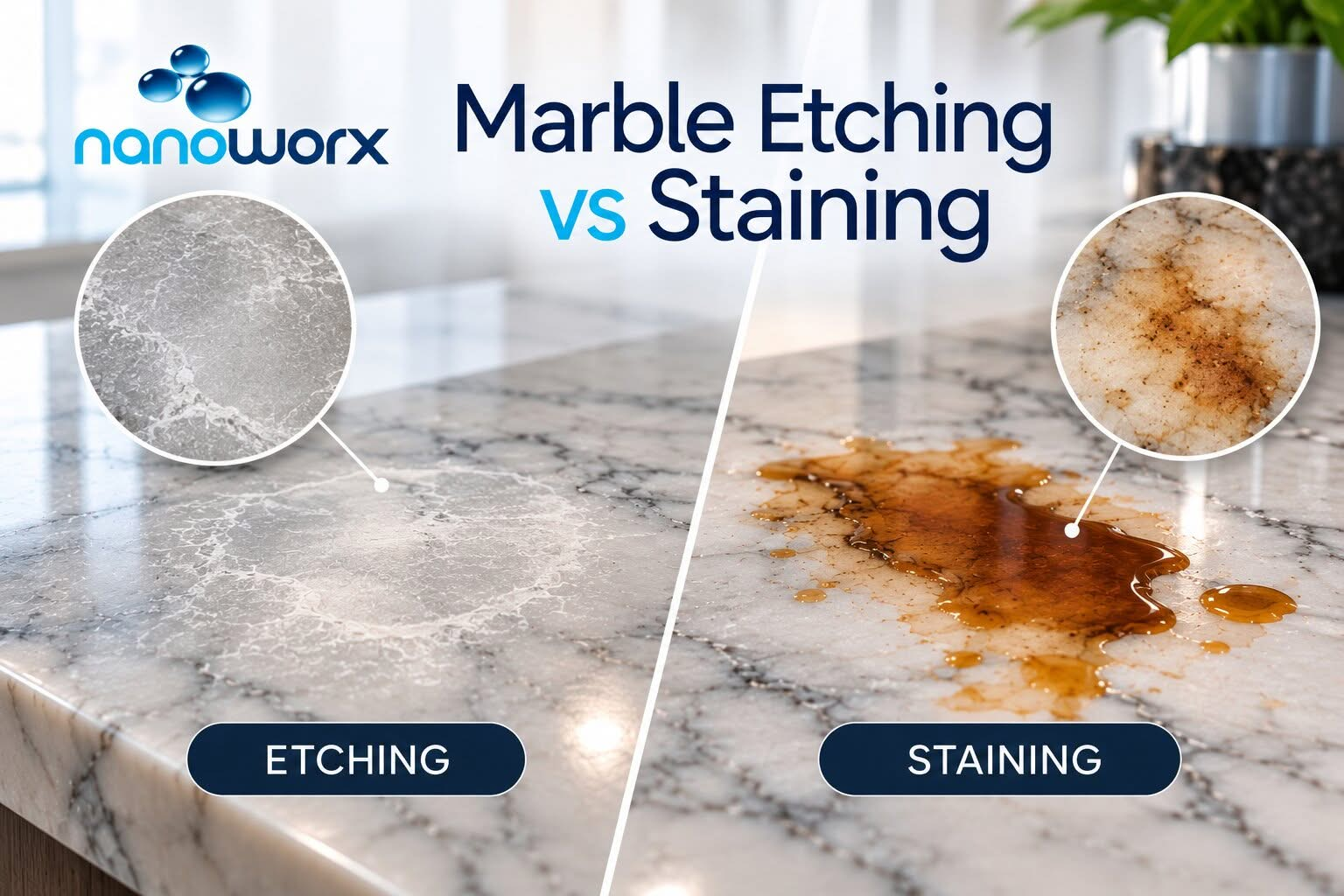
A dull patch or mark on a marble surface does not always mean the same thing. Understanding marble etching vs staining can help you identify what has affected the surface and determine whether it needs cleaning, stain removal, polishing, or more comprehensive restoration.
While etching affects the appearance and finish of marble, staining can leave visible discolouration within the stone. Knowing the difference is particularly useful when dealing with damaged natural stone and deciding whether professional restoration is required.
Marble etching refers to surface damage that can affect marble’s finish and appearance. It can leave sections looking dull, uneven or less reflective than the surrounding surface.
Nanoworx specifically identifies etching as one of the problems that can affect marble surfaces and offers restoration and protection solutions designed to address it. Its marble polishing service covers floors, walls, benchtops, counters, and bars, with the restoration process tailored to the condition of the surface.
Common signs of possible etching include:
For polished marble, even a localised change in surface finish can be highly visible because it reflects light differently from the surrounding stone.
Marble staining is visible discolouration that affects the appearance of the stone. Nanoworx highlights stain removal as part of its marble polishing and stone protection capabilities, particularly because marble surfaces can develop marks that require more than routine cleaning.
Staining may appear as:
The important point is that a mark on marble should not automatically be treated as a stain. The underlying condition of the surface needs to be considered before choosing a treatment.
Nanoworx’s marble polishing service specifically addresses stains and scratches while restoring the appearance of marble surfaces.
The simplest way to understand marble etching vs staining is to look at what has changed: the surface finish, the colour, or both.
| Feature | Marble etching | Marble staining |
| Main visible issue | Dullness or loss of sheen | Discolouration or a visible mark |
| Surface appearance | May look cloudy or uneven | May appear darker or differently coloured |
| Effect on finish | Can affect the appearance of the finish | Primarily presents as a mark or discolouration |
| Typical concern | Restoring the surface finish | Removing or treating the stain |
| Professional treatment | May involve honing or polishing | May require stain removal or restoration |
| Can both occur together? | Yes | Yes |
The distinction is important because different forms of damage can require different restoration approaches. Nanoworx assesses the marble before determining the appropriate work, with its polishing process potentially involving grinding, honing, and polishing depending on the surface condition and desired finish.
A dull spot on marble may indicate etching when the surrounding marble retains its sheen, but one area appears noticeably flatter, cloudier, or less reflective.
Look closely at the surface under normal lighting and consider:
These observations can help identify the type of problem, but appearance alone cannot always establish the cause. Marble can have multiple forms of damage at the same time, which is why professional assessment can be useful when the condition is unclear.
No. Marble etching and staining should not automatically be treated using the same method. The right approach depends on the condition of the marble and the type and extent of damage.
Nanoworx states that its marble restoration process begins with an assessment of the surface before specialised techniques and equipment are selected. Depending on the project, its process can include grinding, honing and polishing to achieve the required finish.
This is particularly important when dealing with damaged natural stone because an unsuitable DIY treatment may fail to address the underlying issue or affect the existing finish.
A professional assessment may be appropriate when marble remains dull, stained, or uneven despite routine cleaning, or when the surface has multiple types of damage.
Nanoworx has completed thousands of restoration projects over 10 years and employs qualified stone masons and tilers, with regular in-house training at its 300 m² warehouse facility. Its Why Choose Nanoworx page provides further information about its experience and restoration expertise.
A professional assessment can help establish:
Nanoworx also showcases a real marble damage repair project among its case studies, demonstrating its experience with marble restoration rather than relying only on general service claims.
Preventing damage starts with appropriate care and considering protection for surfaces exposed to regular use.
Practical measures include:
Nanoworx offers several stone protection solutions. Its Invisifilm Marble Self-Healing Protection Film is specifically designed for marble and natural stone and is positioned by Nanoworx as protection against staining and etching. The product page states that Invisifilm is an ultra-thin polyurethane thermoplastic with self-healing properties and a 10-year limited warranty.
Understanding marble etching vs staining is the first step towards choosing the right restoration approach. A dull, uneven finish may indicate surface damage, while visible discolouration may point towards staining, but both conditions can occur on the same marble surface.
Nanoworx combines marble polishing, stone restoration and protective solutions to help clients move from identifying the problem to restoring the appearance of marble and protecting the finished surface. With more than 1,400 restoration projects completed over 10 years, Nanoworx provides specialist experience for homeowners and commercial clients dealing with damaged natural stone.
Yes. A surface can appear dull or lose its even sheen without the original cause still being visible. Professional assessment can help determine whether the surface requires restoration.
A dull appearance can be related to the condition of the marble surface, including etching, staining, or general wear. If normal cleaning does not restore the finish, professional assessment may be appropriate.
Protection can help reduce certain types of surface damage, but Nanoworx treats protection and restoration as separate considerations. Its stone protection range includes solutions specifically designed to protect marble against staining and etching.
Some marks may require more than routine surface cleaning. Nanoworx provides marble polishing and restoration services that address stains, scratches, and worn finishes according to the condition of the stone.
Yes. A marble surface can have more than one type of damage. Nanoworx’s restoration assessment helps determine the appropriate combination of restoration techniques for the surface.
Yes. Nanoworx provides marble polishing and stone restoration for floors, walls, benchtops, counters, and bars. Its restoration process is assessed according to the condition of the marble.
Yes. Nanoworx offers stone protection solutions, including Invisifilm, which its website describes as protection against staining and etching on marble and other natural stones.

© Nanoworx • Site by c4 Digital Agency